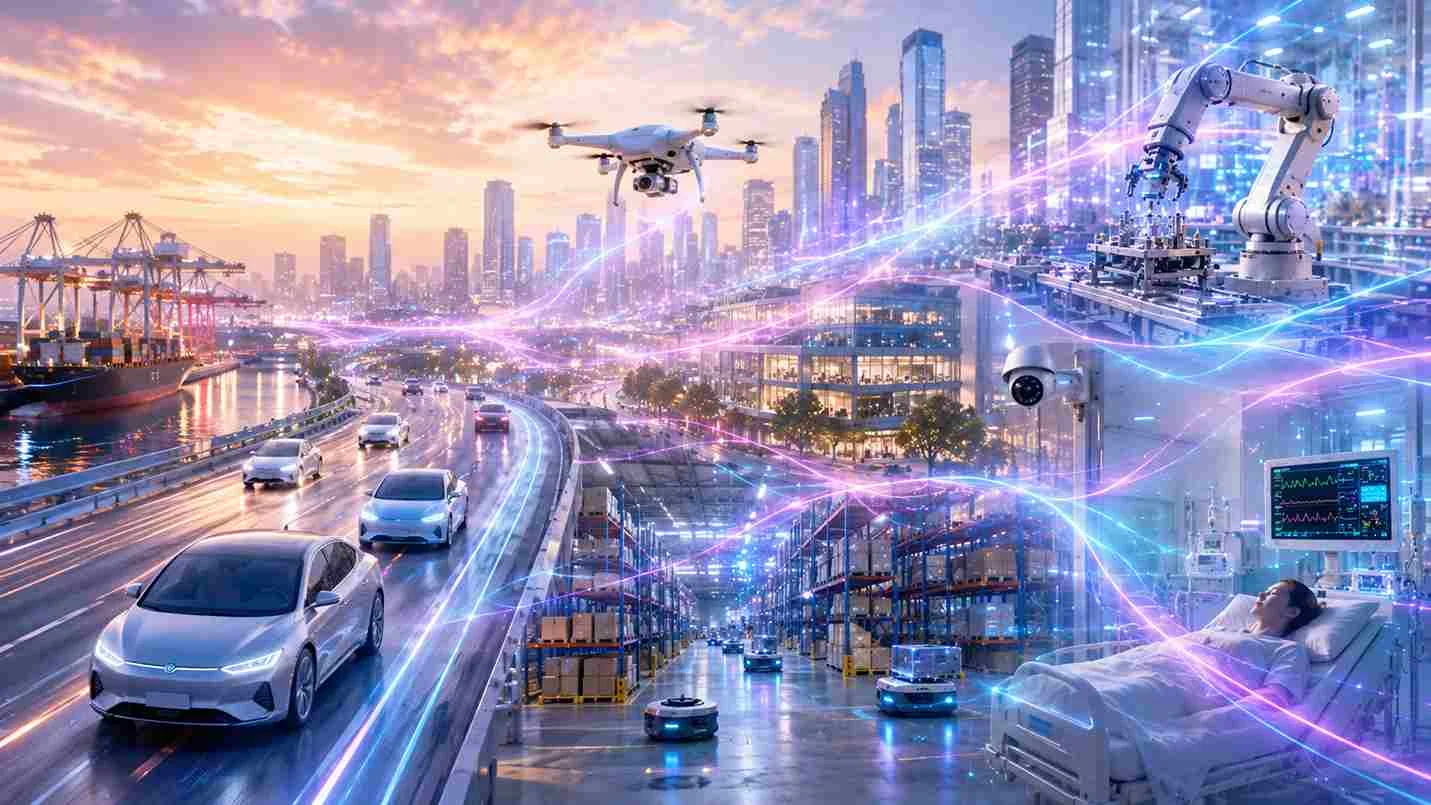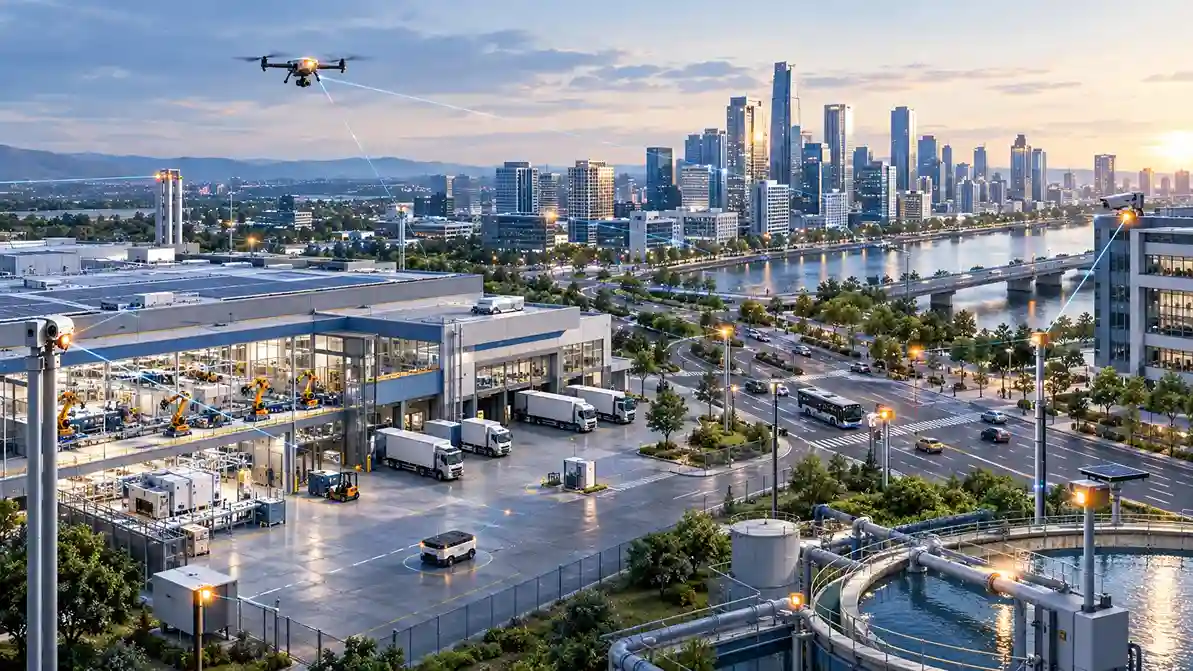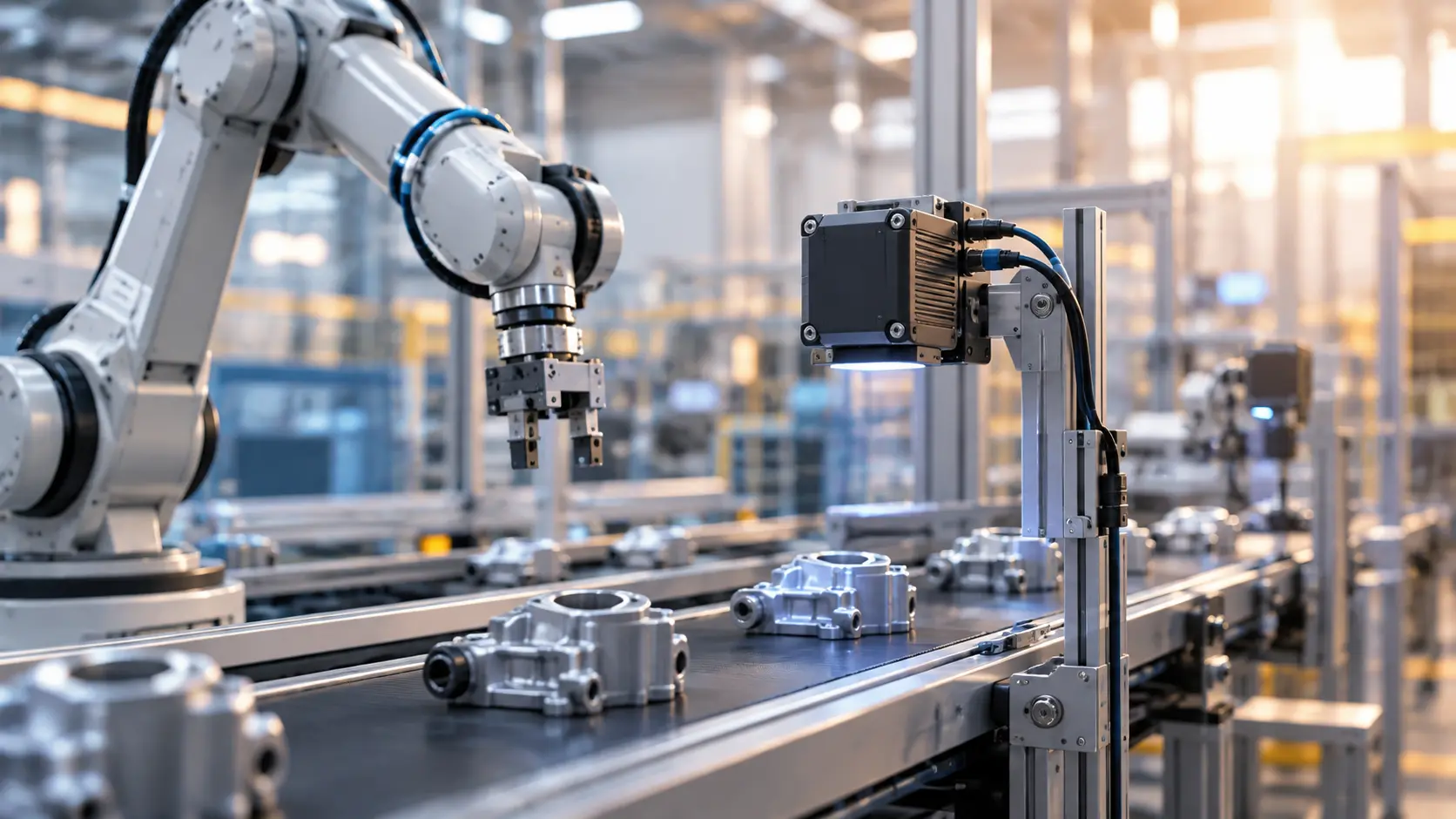
Industrial machines increasingly need to perceive their environment in real time but continuously moving high-volume visual data to external processors creates real challenges in latency, bandwidth, power, and system complexity. As production lines add more cameras, robots take on more autonomous decision-making, and inspection stations run at higher speeds, that conventional capture-and-transfer model is becoming the limiting factor, not the AI models running on top of it.
Sensor-level intelligence, processing visual data at or near the pixel array rather than exclusively downstream, is one architectural response to that constraint. This guide looks at where it applies across industrial automation and smart machines, and what engineering teams should weigh when evaluating it.
Why Industrial Machines Need More Than Conventional Vision
Industrial vision requirements differ from consumer or general-purpose imaging in a few concrete ways:
High-speed production – Inspection and tracking often run at line speeds where a few milliseconds of added latency means a missed part or a misaligned action.
Continuous inspection – Cameras watching a production line don’t get to pause; the system has to sustain throughput across every shift, not just a benchmark run.
Robotic perception – A robot arm or mobile platform needs a tight sensor-to-decision loop to react to a moving part, an obstacle, or a person in its path.
Machine autonomy – As more decision-making moves onto the machine itself, it needs to interpret what it sees locally rather than waiting on a remote system.
Limited compute and power – Many industrial machines, especially mobile or battery-powered ones, can’t carry a full server-class processor and cooling system.
High reliability – A vision system feeding a safety-relevant or quality-relevant decision has to perform predictably, not just on average.
These requirements point toward the same conclusion from different directions: get more of the interpretation done closer to where the image is captured.
Where Conventional Machine Vision Creates Bottlenecks
A typical industrial vision pipeline looks like this: camera → image signal processing (ISP) → processor → AI model → machine decision. Each stage adds time and resource cost, and the effect compounds as systems scale.
Industry bandwidth standards illustrate the problem directly. GigE Vision, the dominant interface for industrial cameras, has had to scale from 1 Gbps toward 10 Gbps and beyond as resolutions and frame rates increased, and industry analysis now frames the constraint less as available bandwidth and more as the host system’s ability to process everything that bandwidth delivers. Below roughly 1 Gbps, standard CPUs handle the load fine; between 2 and 5 Gbps, CPU strain becomes noticeable enough that teams turn to GPUs or FPGAs just to keep up. Interface choice also has a direct latency cost: GigE Vision typically operates in the millisecond range, while CoaXPress, used for high-speed inspection and robotics, operates in the microsecond range, at higher hardware cost.
That trade-off shows up repeatedly across an industrial deployment
Image transfer – Full frames moving across a network or bus consume bandwidth whether or not anything in the scene changed.
Processing overhead – A centralized processor has to reprocess redundant, unchanged pixels alongside the ones that matter.
Centralized compute – Routing every camera’s output to one processing node creates a single point of contention as camera count grows.
Power – Continuous high-bandwidth transmission and processing carries a real power cost, which matters for mobile and battery-powered machines specifically.
Scalability across many cameras – Multi-camera setups are disproportionately affected by bandwidth limits; opening even two cameras at default settings can create contention on a shared link.
How Intelligent Vision Sensors Change the Machine Vision Architecture
Intelligent vision sensors reframe the pipeline from capture → transfer → process to sense → process → interpret → act. Processing and interpretation move earlier, closer to the point of capture, so the machine decision at the end of the chain draws on already-relevant information instead of a full, unfiltered image stream.
That reordering matters most where the “act” step has a tight deadline: a robotic arm adjusting its grip, a conveyor rejecting a defective part, an autonomous vehicle changing course. Industrial perception, robotic control, and machine monitoring all depend on shortening the distance between something happening in the scene and the system knowing about it.
Intelligent Vision Sensors for Automated Inspection
Automated inspection is one of the clearest places sensor-level intelligence pays off, because the core question is direct: can useful information be extracted at the sensing layer instead of continuously moving complete images through the system?
That question applies across common inspection tasks:
Defect detection – Identifying scratches, contamination, or surface anomalies doesn’t require the full image once the defect region has been located.
Quality control – Pass/fail decisions on dimensional or cosmetic criteria can often be resolved from a reduced feature set rather than a full frame.
Assembly verification – Confirming a part is present, correctly oriented, and correctly seated is a localized, not full-frame, problem.
Anomaly detection – Continuous monitoring for rare events benefits directly from a sensor that only needs to report when something changes.
Dimensional inspection – Precise measurement tasks still typically need full image fidelity, a reminder that sensor-level filtering has to match the task, not be applied indiscriminately.
High-speed inspection – At line speeds where each part passes the camera in milliseconds, reducing the sensor-to-decision path directly increases achievable throughput.
The general pattern: the more an inspection task depends on a small, well-defined feature rather than the whole image, the more it benefits from filtering that happens before the data leaves the sensor.
Intelligent Vision Sensors for Smart Machines
Beyond fixed inspection stations, a broader category of smart machines needs continuous, not intermittent, perception: autonomous equipment, industrial robots, warehouse robots, material-handling systems, and other mobile machinery that has to navigate, avoid obstacles, and respond to a changing environment without a hardwired script.
These machines share a common constraint set: they’re often battery-powered, need to sense continuously rather than on a fixed inspection cycle, and can’t always carry a large downstream compute stack without adding weight, heat, and cost. A warehouse robot rerouting around an unexpected obstacle, or a piece of mobile equipment tracking its position relative to moving personnel, needs perception that keeps pace with its own motion, not a perception system waiting on a network round-trip. This is where “smart machines” becomes a more useful frame than “machine vision” alone: the sensor isn’t just capturing images for a human or a downstream algorithm to review later, it’s a continuous input to the machine’s own control loop.
What Industrial Engineers Should Evaluate
Selecting a vision architecture for an industrial or robotic application comes down to matching sensor characteristics to system-level constraints:
Latency – What’s the actual deadline for the downstream decision, and how much of that budget can transmission and processing consume?
Power consumption – Is the machine battery-powered or SWaP-constrained, and what’s the realistic power envelope for sensing plus processing?
Sensor resolution – Does the task need full resolution, or would a reduced or selectively-read-out output suffice?
Output data rate – How much data does the sensor need to transmit downstream, and does that fit the available interface and bus?
Processing location – Should interpretation happen at the sensor, at the edge, or in a hybrid split, given the application’s latency and connectivity constraints?
Programmability – Can one sensor be reconfigured across multiple product variants or tasks, or does each application need dedicated hardware?
Integration – What’s the hardware and software integration effort to bring the sensor into an existing machine or line architecture?
Environmental requirements – Lighting variability, vibration, temperature range, and enclosure constraints specific to the industrial or mobile environment.
Reliability – Can the sensor sustain continuous operation across shifts without performance drift or unplanned downtime?
System-level compute requirements – What does sensor-level filtering remove from the downstream processor’s workload, and does that change what processor the system actually needs?
How OCULI SPU Enables Intelligent Vision for Smart Machines
Mapped against the constraints above, Oculi’s architecture addresses each one directly,
High visual data volume – OCULI’s approach: IntelliPixel® processes information at the pixel, so a filtered, task-relevant output not a continuous full-frame stream is what leaves the chip.
Sensor-to-processor latency – sensor-level processing removes the transmission and re-processing steps that add delay in a conventional camera-plus-processor pipeline.
Different machine applications on different lines – the Software-Defined Vision Sensor™ architecture lets the same SPU hardware be reconfigured for different detection tasks or frame-rate/power profiles, rather than requiring a new sensor variant per application.
Power-constrained – reducing unnecessary data movement lowers the power draw tied to transmitting and reprocessing redundant frames.
For teams testing this against a specific line, robot, or mobile platform, Oculi’s Evaluation Programs offer the Magenta kit for general-purpose industrial and machine vision tasks. For the underlying sensor architecture in more depth, see how the SPU transforms AI vision sensors. If you’re scoping an industrial or robotics application against these constraints, contact Oculi to discuss your specific requirements.
Frequently Asked Questions
Do intelligent vision sensors replace industrial cameras entirely?
Not necessarily. Many deployments still use a conventional camera path for tasks that genuinely need full-frame image quality, alongside sensor-level intelligence for tasks where filtering at the source is a better fit.
Can sensor-level processing keep up with high-speed production lines?
Because processing happens closer to capture rather than after a full transmission step, it’s generally well suited to high-speed lines the actual answer depends on the specific frame rate, resolution, and decision deadline involved.
Is sensor-level intelligence the same as edge AI?
No. Edge AI moves compute off the cloud but typically still works from a full frame handed off by the sensor. Sensor-level intelligence changes what the sensor sends in the first place.
How do engineers start evaluating this for a specific machine?
By mapping the application’s actual latency budget, power envelope, and data-output needs against a specific sensor’s programmability and integration requirements, typically through a structured evaluation kit rather than a datasheet alone.