
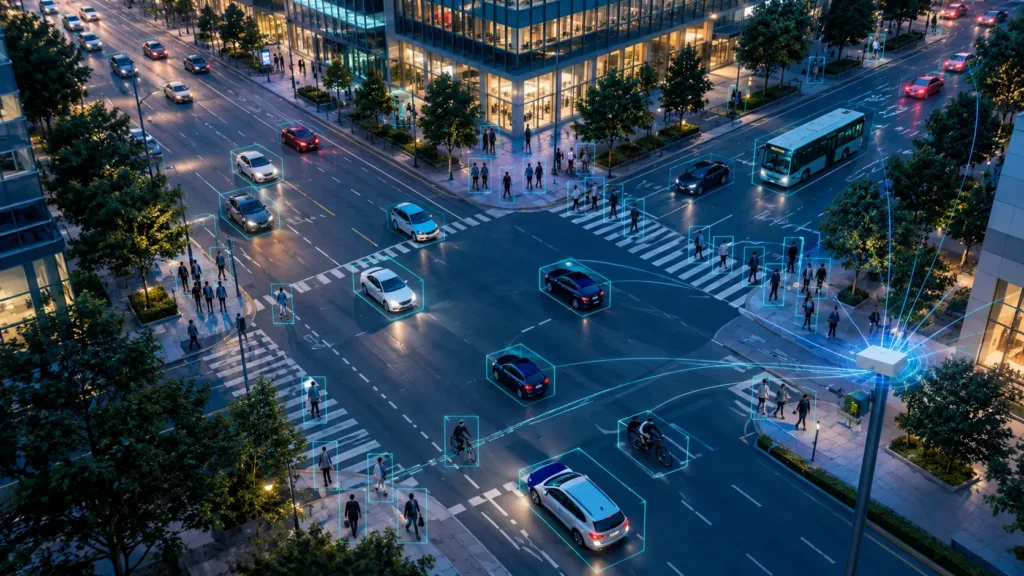
Edge AI for smart cities means analyzing camera and sensor data on or near the device that captures it, rather than streaming raw video to a distant cloud. Common edge AI applications in smart cities include real-time urban monitoring of traffic flow, pedestrian counts, and parking occupancy. Local processing delivers faster insights, uses less bandwidth, and keeps raw footage off the network.
The pressure on cities is real. INRIX found that U.S. drivers lost an average of 43 hours to congestion in 2024, at a cost of $771 each. NHTSA reports 7,080 pedestrians killed in U.S. traffic crashes that year, and 76% of those deaths happened in the dark. Connected cameras also generate more video than cities can store or review.
Edge AI offers a practical answer: analyze visual data close to where it is captured and pass along only what matters.
Edge AI for Smart Cities Explained
In edge computing for smart cities, AI models run on or near cameras, sensors, or roadside devices. The edge can be a street-cabinet gateway, a processor beside a camera, or the sensor itself. This is on-device AI processing.
Cloud-based processing works differently. Each video stream travels to a remote data center for analysis. That adds delay, consumes bandwidth, and moves raw footage across networks.
With edge AI, the device reports a result, such as a vehicle count or an alert. The video stays local. See also OCULI’s guide to edge AI use cases by industry.
Real-Time Traffic Monitoring
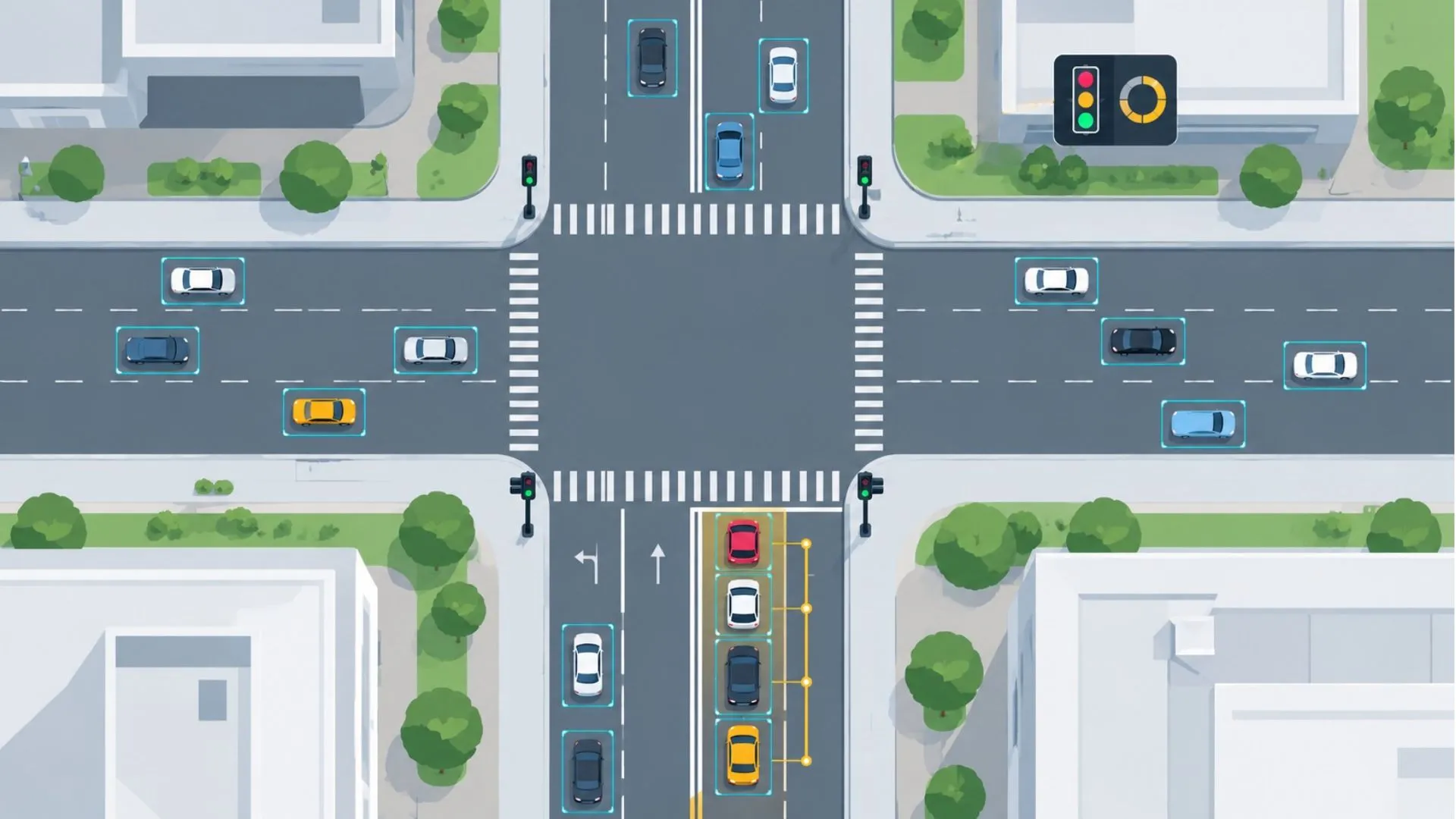
Smart city traffic monitoring starts with basic measurements. Computer vision for smart cities can count vehicles, classify them by type, and estimate traffic density. It can also measure queue length at a stop line, flag stalled vehicles, and watch an entire intersection.
Edge AI for traffic management runs these checks at the roadside. A stalled vehicle needs attention within seconds, and a growing queue needs a signal response now, not after a batch upload.
The Federal Highway Administration reports that adaptive signal control improves travel time by more than 10 percent on average. That technology relies on timely detection data. Fresh counts and queue measurements give engineers what they need for traffic congestion detection and an intelligent traffic management system that responds as conditions change.
Pedestrian Counting and Movement
AI-powered pedestrian detection finds people in a scene. Tracking follows each person across frames. Counting then tallies movement through a defined line or zone. Together, these steps power pedestrian counting technology.
Useful outputs:
- Counts by hour or day
- Direction of travel
- Crossing activity at a signal
- Crowd density on a platform or plaza
- Pedestrian flow analysis at intersections and transit stations
Counting people is not the same as identifying them. A counter needs to know that someone crossed a line. It does not need a name or a face. Well-designed systems report only numbers and movement patterns.
The same NHTSA data shows 84% of pedestrian deaths occurred in urban areas. Knowing where and when people cross helps cities prioritize lighting, crosswalk timing, and signal phasing.
Smart Parking and Occupancy
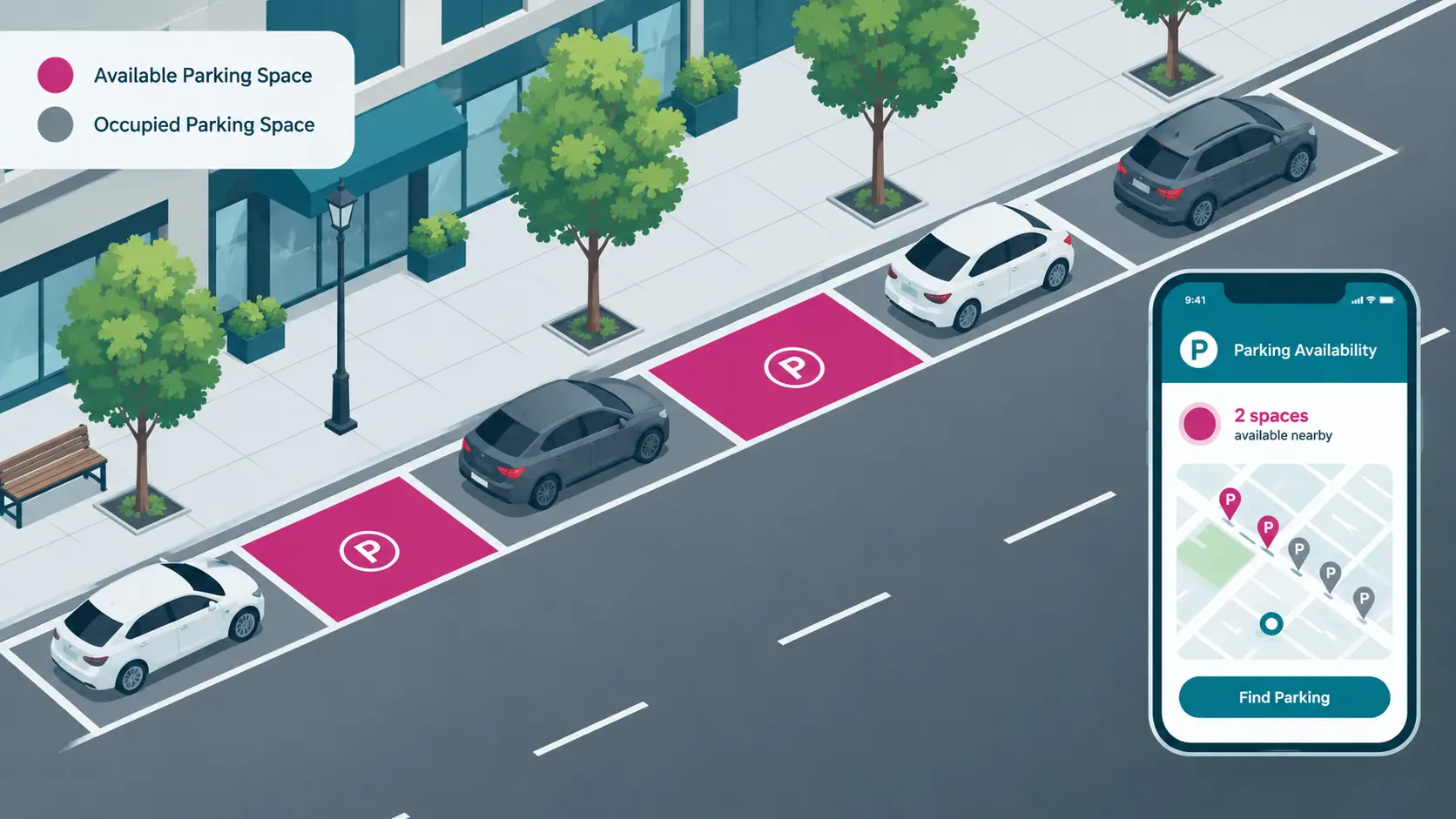
A smart parking system detects whether each space or zone is occupied. From that, it can calculate occupancy rates, track turnover, and publish real-time parking availability.
Drivers get directions to open spaces. Operators see which areas fill early, which supports pricing, enforcement, and signage decisions.Parking occupancy detection is most valuable when it targets the specific blocks where search behavior causes problems.
Privacy-Conscious Urban Sensing
Continuous video of public spaces creates real concerns. Streaming and storing it expands exposure, raises data-management costs, and invites public pushback. Privacy-first urban monitoring starts with collecting less.
Edge AI video analytics supports this in four ways:
- Local processing: analysis happens at the device.
- Data minimization: only the needed output leaves it.
- Limited retention: any stored data is deleted on a short, defined schedule.
- Aggregate sharing: counts and event metadata replace raw footage where appropriate.
This mirrors the data minimization principle in Article 5 of the GDPR, which limits personal data to what is necessary for its purpose.
Privacy-preserving computer vision is not automatic. Camera placement, access controls, notice, and applicable law still matter.
Edge AI vs Cloud Analytics
The main differences:
- Processing location: edge runs at or near the camera; cloud runs in a remote data center.
- Latency: edge enables low-latency AI processing; cloud adds a network round trip.
- Bandwidth: edge sends results; cloud receives streams.
- Cloud dependence: edge keeps working through outages; cloud analysis stops.
- Scalability: edge adds capacity device by device; cloud scales centrally but multiplies transport costs.
- Data exposure: edge limits what leaves the site; cloud moves raw footage.
Edge AI vs cloud AI is not an either-or choice. Hybrid architectures work well. Edge devices handle live decisions. Cloud systems host centralized dashboards, historical trend analysis, and model training.
Intelligent Vision Sensors
Conventional systems pair a camera with a separate processor. The image sensor captures full frames. Those frames travel to another chip or server, where AI interprets them. Moving that data costs power and time.
Intelligent vision sensors change the order. Sensor-level processing handles part of the analysis where light is captured. OCULI calls this in-pixel computing.
The OCULI SPU™ uses IntelliPixel® technology. Each pixel includes its own logic and small memory, so it can decide whether something of interest is happening. OCULI says this turns a gigabits-per-second data problem into a kilobits-per-second one.
The SPU is also a Software-Defined Vision Sensor™. Software settings change what the chip outputs, from full-frame video to a minimal stream of actionable information. OCULI lists smart-city traffic and pedestrian monitoring among its demonstrated applications and reports sub-5 ms decisions with no cloud round trip.
Explore Our Technology or the guide to intelligent vision sensors.
Deployment Challenges
Cities should weigh these trade-offs:
- Lighting and weather: glare, darkness, rain, and fog affect detection.
- Occlusion: buses hide pedestrians, and crowds overlap.
- Counting accuracy: validate against manual counts at each site type.
- Camera placement: height and angle shape results.
- Device power: many poles lack easy power, so efficiency matters.
- Network integration: devices must work with existing signal controllers and platforms.
- Cybersecurity: NIST’s IoT device cybersecurity baseline offers a starting point for evaluating devices.
- Maintenance: updates, monitoring, and replacement across many devices add up.
Before scaling, run a pilot at representative sites. Measure accuracy, false alarms, uptime, power use, and maintenance effort against the current approach.
OCULI’s Evaluation Programs let teams test the SPU on their own use case.
Frequently Asked Questions
What is edge AI in smart cities?
Edge AI in smart cities is local AI processing on or near cameras and sensors. Devices turn video into counts and alerts for traffic, pedestrian, and parking uses without sending every frame to the cloud.
How does edge AI improve traffic monitoring?
It detects and classifies vehicles on the device, then measures density and queues locally. Operators get insights within moments.
How is AI used for pedestrian counting?
AI detects people, tracks them across frames, and counts those who cross a defined line or enter a zone. Direction and density come from the same data.
How does edge AI help reduce traffic congestion?
It supplies live data for monitoring and signal optimization. Adaptive signal control, which depends on such data, improves travel time by more than 10 percent on average, according to FHWA. Edge AI supports congestion management but does not solve it alone.
What is the difference between edge AI and cloud AI?
Edge AI processes data at or near the source, giving lower latency, less bandwidth use, and continued operation when connectivity drops. Cloud AI processes data in remote data centers, which suits training and citywide analysis.
How can smart cities monitor traffic while protecting privacy?
Process video locally, share counts or event metadata instead of footage, and set short retention limits. Add access controls and clear notice.
How does AI-powered parking occupancy detection work?
A vision model examines defined spaces or zones and classifies each as occupied or available. Results update displays, apps, and dashboards.
What are the challenges of implementing edge AI in smart cities?
Lighting, weather, occlusion, camera placement, power, integration, cybersecurity, and fleet maintenance. A pilot at representative sites helps cities measure these trade-offs first.