Cameras have traditionally done one job capture an image and send it somewhere else to be understood. An AI vision sensor changes that relationship by moving part of the intelligence into the sensor itself, so a system can start making sense of what it sees closer to the point of capture.
This matters because more devices than ever need to see and react in real time robots, smart machines, industrial equipment, and autonomous systems often with strict limits on power, size, and bandwidth. Traditional camera-plus-processor architectures were not designed with those constraints in mind.
Understanding AI Vision Sensors
An AI vision sensor is an image sensor that performs some level of visual data processing, filtering, or interpretation directly at or near the pixel array, rather than sending every raw frame to a separate processor for analysis.
In a conventional imaging pipeline, the sensor’s only job is to convert light into a digital image. All the “thinking” detecting motion, recognizing shapes, tracking objects happens downstream, on a separate application processor or GPU. An AI vision sensor shifts some of that thinking earlier in the pipeline.
The result is a sensor that doesn’t just capture a scene, it can help determine what is relevant in that scene before the full image ever leaves the chip.
Core Functions of an AI Vision Sensor
At a functional level, an AI vision sensor typically does one or more of the following:
- Detects motion, changes, or events in the field of view
- Extracts features (edges, contrast, patterns) relevant to a task
- Reduces or filters the data that needs to be transmitted or processed further
- Supports downstream tasks like object detection, tracking, or gesture recognition
The exact split of “what happens on-sensor vs. off-sensor” varies by architecture, which is why understanding sensor design matters when evaluating options.
AI Vision Sensor vs. Traditional Camera Sensor
A normal camera sensor is a passive data-capture device it outputs a full stream of pixels and leaves interpretation entirely to external hardware and software. An AI vision sensor participates in the interpretation process.
| Aspect | Conventional Camera Sensor | AI Vision Sensor |
| Primary function | Capture and output raw pixels | Capture and partially process visual data |
| Where processing happens | External processor/GPU | At or near the sensor (in-sensor or in-pixel) |
| Data sent downstream | Full frame, every frame | Often reduced, filtered, or event-based data |
| Power profile | Depends heavily on external compute load | Can be lower, since less raw data moves and is processed elsewhere |
| Latency | Added by transmission + external processing | Can be reduced by processing closer to capture |
Inside an AI Vision Sensor: Architecture and Processing
An AI vision sensor works by combining light-sensing hardware with computation that happens at, or very close to, the pixel array rather than only at a downstream processor.
At a high level, the process generally follows this sequence:
- Photodetection – The pixel array converts incoming light into electrical signals, the same fundamental step used in any image sensor.
- On-sensor or in-pixel processing – Instead of immediately reading out a full raw frame, circuitry at or near the pixel level performs early processing, such as detecting change, extracting relevant features, or filtering out static background information.
- Selective data output – The sensor outputs only the data that matters for the task this might be event information, reduced feature data, or a processed representation of the scene, instead of a constant stream of full frames.
- Downstream interpretation – Any remaining processing (classification, decision-making, application logic) happens on a host processor, but with a smaller, more relevant dataset to work with.
This division of labor is what allows AI vision sensors to reduce the burden that would otherwise fall entirely on a separate application processor.
It also helps to see how the main architectural approaches relate to one another, since “in-sensor processing,” “in-pixel computing,” and “edge AI vision” are related but distinct concepts, not interchangeable synonyms:
| Architecture | Where Processing Happens | Typical Data Flow | Main Architectural Consideration |
| Conventional image sensor | Downstream CPU/GPU/NPU | Sensor → raw image data → processor | Large volumes of raw visual data may move downstream for every frame |
| In-sensor processing | Within or near the sensing subsystem | Sensor → processed/filtered data → system | Can reduce unnecessary data movement before it leaves the sensor package |
| In-pixel computing | At the pixel level | Sense + compute → relevant information | Computation occurs at the point of capture, closer to the source than in-sensor processing alone |
| Edge AI vision | At or near the edge device | Sensor → edge processing → application | Enables local visual interpretation without relying on cloud connectivity |
In-Sensor Processing Explained
In-sensor processing refers to performing computation on visual data within the sensor package itself, before that data is sent to an external processor. This can include tasks like motion detection, basic feature extraction, or data reduction.
The direct benefit is that the external system no longer has to process every raw frame; it only receives data that has already been filtered for relevance.
What Is In-Pixel Computing?
In-pixel computing takes this concept a step further by embedding processing capability at the level of individual pixels or small pixel groups, rather than only in circuitry surrounding the full sensor array.
Because computation happens where the light is actually captured, in-pixel computing can reduce the amount of raw data that ever needs to move off the pixel array in the first place. This is the architectural principle behind Oculi’s IntelliPixel® technology, which is designed around performing computation directly within the pixel structure rather than exclusively downstream of it.
Visual Information Processing at the Sensor Level
Processing visual information at the sensor level generally relies on specialized circuitry designed to perform lightweight, task-specific operations such as comparing pixel values over time to detect change, or extracting basic spatial features without needing the full computational overhead of a general-purpose processor.
This is different from traditional computer vision pipelines, where a general-purpose CPU or GPU applies algorithms to a full, unfiltered image after the fact.
Role Of Edge AI
Edge AI refers to running AI-related processing physically close to where data is generated, rather than sending it to a centralized server or cloud system. In the context of vision sensors, edge AI vision means the visual interpretation or at least a meaningful part of it happens on-device, near or within the sensor.
This matters for applications where connectivity is unreliable, latency is critical, or sending continuous video to the cloud is impractical or undesirable from a bandwidth or privacy standpoint.
How Oculi Approaches AI Vision Sensors
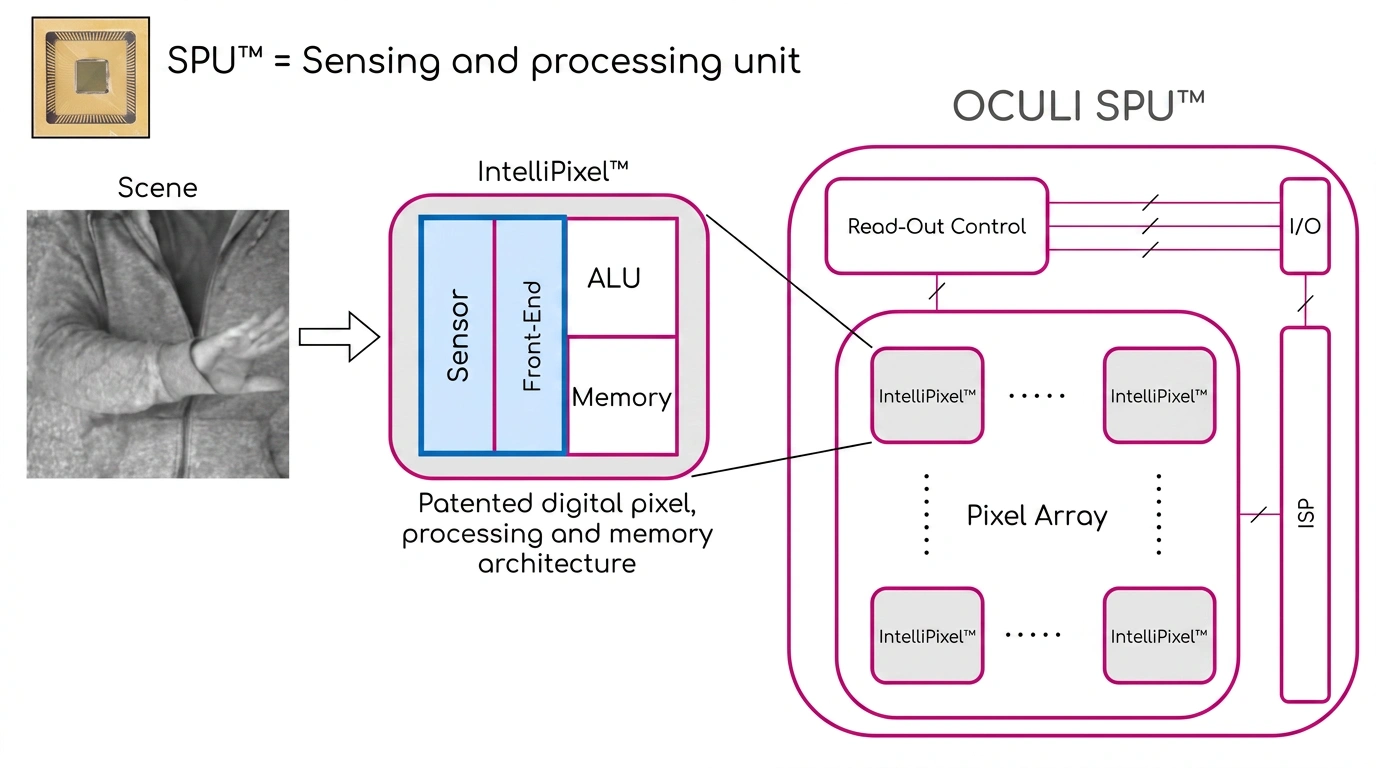
OCULI SPU is organized around four main blocks: a pixel array built from IntelliPixel® units, a read-out control block that manages how data is read from that array, an I/O block that interfaces with the host system, and an ISP (Image Signal Processor) stage. Sensing and processing are integrated into this single unit rather than split across a sensor chip and a separate downstream processor.
IntelliPixel® works conceptually. Each IntelliPixel® is a self-contained unit combining a sensor, a front-end, an ALU (arithmetic logic unit), and memory. Oculi describes this as a patented digital pixel, processing, and memory architecture. Rather than a pixel being a purely passive light-to-charge element, each IntelliPixel® can sense, condition, compute on, and locally store information about its own input.
How the architecture differs from conventional camera + processor systems. A conventional system captures full frames and sends them to a separate processor for every processing task. Oculi’s approach is designed to shift meaningful processing into the sensing stage itself, so the system downstream can work with already-relevant information rather than raw, unfiltered frames.
Benefits of AI Vision Sensors
AI vision sensors generally stem from one core idea doing some processing earlier, closer to where the image is captured, reduces the work and the data that has to travel further downstream.
Reduce Power Consumption
When a sensor filters or reduces data before it leaves the chip, there is less data to transmit and less external processing required, which can lower overall system power draw. The actual power impact depends on the specific sensor design, workload, and system architecture.
Reduce Latency
Processing visual data closer to the point of capture can reduce the delay between “something happens in the scene” and “the system knows about it,” because there are fewer steps and less data standing between capture and a usable output.
Reduce Data Movement
Only the meaningful portion of that data needs to be transmitted to downstream systems instead of continuous full-frame video.
Applications and Use Cases for AI Vision Sensors
AI vision sensors are relevant anywhere a system needs to see and interpret its environment under constraints on power, size, latency, or bandwidth. Common application areas include:
- Robotics – for perception tasks like navigation, obstacle awareness, and object interaction
- Smart machines and industrial automation – for monitoring, inspection, and process control in manufacturing environments
- Smart devices – where battery life and compact form factors limit how much processing can happen off-sensor
- Smart buildings – for occupancy sensing, security, and automation without relying on constant video streaming
- Smart cities – for infrastructure monitoring and traffic-related applications at scale
- Autonomous systems – where fast, reliable perception directly affects safe operation
- Defense and unmanned systems – where low-latency, low-power perception can be operationally important.
What Should Engineers Consider When Selecting an AI Vision Sensor?
Key considerations typically include:
- Application requirements – What does the system actually need to detect or interpret, and how fast does it need a response?
- Power budget – Is the device battery-powered, and how much power can be allocated to sensing and processing?
- Data output needs – Does the downstream system need full images, or would reduced/event-based data be sufficient?
- Integration complexity – What hardware and software integration work is required to bring the sensor into an existing product architecture?
- Programmability – Can the sensor be reconfigured for different tasks, or is it fixed to a single function?
- Environmental conditions – Lighting variability, motion characteristics, and physical constraints of the deployment environment.
None of these can be properly assessed from a datasheet alone, which is why real-world testing matters.
Oculi Evaluation Programme
Magenta Evaluation Kit — broad-purpose, developer-friendly API, for vehicle security/sentry systems, smart devices, intelligent machines, industrial machine vision
Burgundy Evaluation Kit — Magenta specialized for presence detection: building automation (lighting/HVAC), security, occupancy monitoring, access control
Software Simulators — no-cost, software-only versions of Magenta/Burgundy that run on a laptop with a built-in or USB camera; good entry point for individuals, small teams, or as a first step before larger companies commit to the full kits
Oculi’s Evaluation Programme is designed to let engineering teams assess the OCULI SPU and IntelliPixel® in-pixel computing approach through a structured, application-relevant process, rather than relying on specifications alone.
Conclusion
An AI vision sensor represents a shift in how visual data is captured and processed moving part of the intelligence closer to where light first becomes information, rather than leaving all interpretation to a downstream processor. Through approaches like in-sensor processing and in-pixel computing, these sensors can help reduce data movement, power consumption, and latency in systems where those factors matter most.
For teams building robotics, smart machines, industrial automation, or autonomous systems, evaluating an AI vision sensor is ultimately a question of fit: does its architecture match your application’s power, latency, and data requirements?
If you are evaluating vision technology for a product or application, Oculi can help you determine whether its Software-Defined Vision Sensor™ and in-pixel computing approach fits your requirements. Contact Oculi to discuss your use case or explore the Evaluation Programme.
Frequently Asked Questions
What is an AI vision sensor?
An AI vision sensor is an image sensor that performs some level of visual data processing at or near the pixel array, rather than sending all raw image data to a separate processor for analysis.
How is an AI vision sensor different from a regular camera sensor?
A regular camera sensor only captures and outputs raw pixel data. An AI vision sensor participates in interpreting that data, often by filtering, detecting change, or extracting features before the data leaves the sensor.
What is in-pixel computing?
In-pixel computing is an approach where processing happens directly at the level of individual pixels or small pixel groups, rather than only in circuitry surrounding the sensor array, which can reduce how much raw data needs to move off-chip.
Can AI vision sensors help reduce power consumption?
Yes. Processing and filtering data closer to the sensor can reduce the amount of data that needs to be transmitted and processed externally, which can lower overall system power use, though the exact impact depends on the specific design and workload.
Are AI Vision Sensors Useful for Robotics?
Yes. Robots often need to perceive and react to their environment in real time, frequently on limited power budgets. Sensors that reduce the volume of data needing full downstream processing can help robotic systems respond faster and operate more efficiently.
Are AI Vision Sensors Useful for Smart Buildings?
Yes, particularly for use cases like occupancy detection or basic activity monitoring, where continuous full-video analysis isn’t necessary and a more efficient, privacy-conscious approach to sensing is preferable.
Are AI Vision Sensors Suitable for Battery-Powered Devices?
They can be well suited to battery-powered devices, since reducing the amount of data processed and transmitted is one of the more direct ways to reduce overall system power consumption a critical factor for anything not connected to continuous power